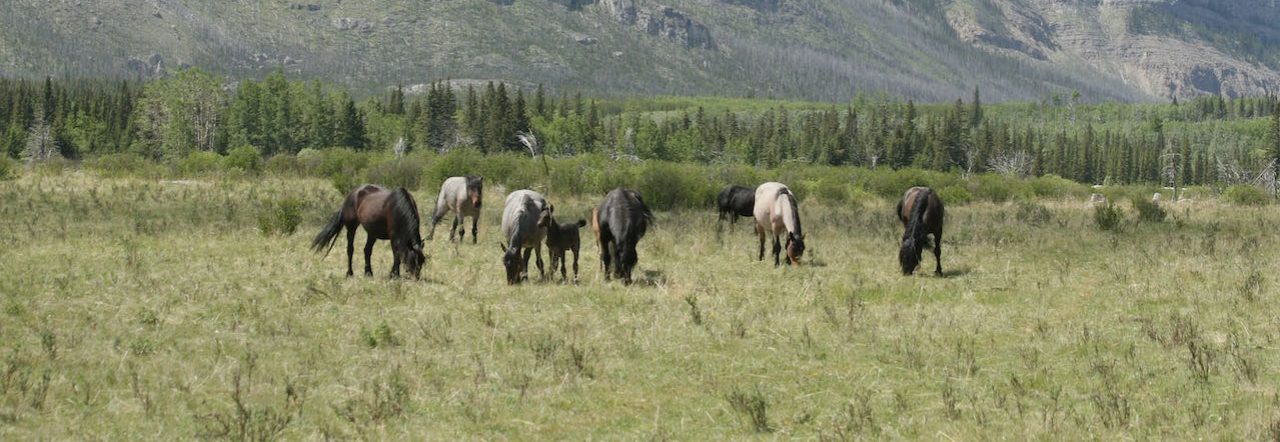
We would like to acknowledge that the Alberta Mountain Horses inhabit the traditional lands of the Stoney lyethkabi, (mountain) people.

The Alberta foothills have long been known as wild horse country — vast, rugged, and resilient. But after spending three days in the air participating in an aerial horse count across the Sundre and Clearwater equine zones, one thing became abundantly clear: this landscape is changing, and it’s changing fast.
Aerial Insights: Counting Alberta’s Mountain Horses
Recently, I had the opportunity to assist in an aerial Alberta Mountain Horse count conducted by HAWS. Flying south-to-north grid patterns by helicopter over the Sundre and Clearwater zones, we surveyed the land under excellent conditions — solid snow cover, clear visibility, and warm temperatures.
Though officially referred to as a “minimum count,” the tight grid pattern, slow speeds, and low altitudes made it unlikely that many horses were missed. Against the snow, even horses partially sheltered by trees stood out clearly.
The results:
- Sundre Zone: 1,013 horses across 544,898 acres
- Clearwater Zone: 195 horses across 515,911 acres
That works out to approximately:
- 1 horse per 530 acres in Sundre
- 1 horse per 2,645 acres in Clearwater
While these numbers are higher than previous years, the increase appears tied to thorough coverage rather than a population explosion.

A Question of Balance
Now consider this comparison:
During grazing season, Alberta’s Rangeland Management Department permits:
- 7,285 cattle in the Sundre area
- 2,255 cattle in Clearwater
Measured in Animal Unit Months (AUMs), the scale of cattle presence dwarfs that of the wild horses. In parts of northern Sundre — where natural open valleys and meadows are nearly nonexistent — cattle graze primarily along manmade corridors such as pipeline and power line clearings.
This raises an important question: if habitat pressure is a concern, why does scrutiny fall so heavily on wild horses?


A Landscape Transformed by Logging
What struck me most from the air wasn’t the number of horses — it was the scale of clearcut logging.
In the northern Sundre zone, east of the Forestry Trunk Road, very little old-growth forest remains. Vast tracts have been harvested and replanted. While companies like West Fraser deserve credit for thorough cleanup after logging operations, the replanting often results in monoculture forests — uniform stands lacking the biodiversity of the original ecosystem.
In contrast, practices by Spray Lakes Sawmill show a different standard of site restoration.
Even as we conducted the horse count, active clearcutting was underway in areas of mature forest still standing. West of the Forestry Trunk Road, logging now extends deep into previously remote valleys such as Limestone and Cutoff Creek. Areas once considered untouched winter refuge are now threaded with new roads and heavy machinery.
It is difficult not to feel a sense of loss witnessing this transformation from above.


Wildlife Displacement: The Silent Impact
In recently logged regions of northern Sundre, wild horses have migrated east and south to avoid disturbance and noise. Their adaptability is remarkable.
But many species are not so fortunate.
The destruction of mature forest habitat impacts:
- Pine squirrels
- Pine martens
- Canadian lynx
- Wolverines
- Weasels
- Numerous small rodents
These species rely on complex, mature forest ecosystems. When habitat disappears, many do not simply relocate — they perish.


From the air, another absence became evident: fewer deer, moose, and elk in areas where they once thrived. Habitat loss has pushed them elsewhere. Yet, public discourse often focuses on wild horses as the primary ecological concern, overlooking the cumulative impacts of logging and industrial expansion.
Remote Valleys No More

Consider the Limestone valley. Previously, access gates closed on December 1 to protect winter wildlife habitat. Today, new logging roads and active operations extend deep into this once-protected area.
In parts of the Clearwater backcountry, elk once used these valleys as wintering grounds. They are no longer there.
Small populations of wolverine — a species considered at risk by some experts — have also been reported in valleys now undergoing logging activity. These animals depend on remote, undisturbed landscapes. Once fragmented, such habitats are rarely restored to their original ecological complexity.
The question becomes unavoidable: what happened to wildlife conservation priorities?
Rethinking Responsibility
Alberta’s mountain horses have proven adaptable. They move, adjust, and survive amid ongoing industrial activity. Their resilience, however, should not make them convenient scapegoats.

Blaming wild horses for ecological degradation ignores broader land-use pressures:
- Large-scale logging
- Expanding road networks
- Intensive cattle grazing
- Resource extraction policies
If deer, elk, and moose populations decline in certain regions, it is worth examining the cumulative effects of habitat fragmentation before pointing to one highly visible species.
A Call for Balanced Management
The Alberta foothills are a shared public landscape. Management decisions should reflect long-term ecological health, not short-term economic gain.
Effective stewardship means:
- Protecting critical wintering habitats
- Maintaining biodiversity in forest regeneration
- Evaluating cumulative industrial impacts
- Managing wildlife populations based on comprehensive data
Wild horses are part of this ecosystem — not apart from it.

From the air, the story unfolding across the foothills is not simply about horse numbers. It is about land use, habitat loss, and the future of Alberta’s wild spaces.
The Alberta foothills are changing. The real question is how we choose to manage that change.
This is so sad what Canada is doing to their rangeland. Their beautiful forrests are disappearing and you’ll never get the diversity back. Nor will you get the same population that rely on that ecosystem that has been disturbed or vanished due to this. The rock coat is horrible and should be cut to the ground and not loved in the state it is. It also should be replanted immediately to protect the soil and the erosion. We have stopped vacationing in Canada due to this, and the disappearing of where we once enjoyed visiting.
Please, please everyone pressure our Alberta government to protect the few wilderness areas that are left . Also heavily consider your vote in our next election. Vote for the leader that will pass protection laws that are so badly needed not the person we presently have.
I live in New Zealand and diligently follow HAWS, they do a wonderful job of keeping us up to date with events. It all comes down to HUMAN GREED no thought whatsoever for the eco system. It is appalling that they are using the Wildies as scapegoats they are doing no harm, it is the HUMANS that are the problem, I guess the Goverment is only concerned about the monetary side. The horses are beautiful, they get one with their lives, their bands are amazing, I have learnt a lot about the way of the Wildies. PLEASE GOVERNMENT SIT UP AND LISTEN TO THE PEOPLE WHO CARE ABOUT THE ECOSYSTEM.