We would like to acknowledge that the Alberta Mountain Horses inhabit the traditional lands of the Stoney lyethkabi, (mountain) people.

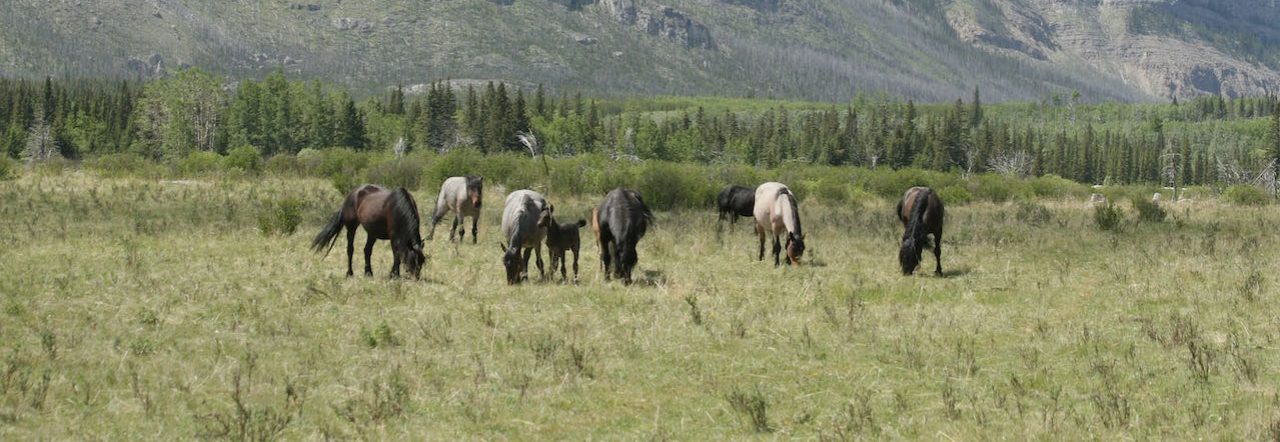
The above picture of a wild horse mare wearing a tracking collar was just taken this past week by a wild horse advocate. This poor mare has been wearing this collar for eight years now. As you can see the collar seems way too tight on the mare as there are folds of skin behind it. Right now she has a foal beside her and she may be pregnant again. So at this point I just want to put out the facts surrounding the collars being part of a research program.
In 2018 a research project was undertaken by the University of Saskatchewan’s Animal Science Department of Biology. Under the supervision of Dr. P. McLoughlin and with a graduate student, Paul Broyce, who would write his theses on this study of Alberta’s wild horses, the project began.
The proposal was called the “Ecology and Management of Feral Horses in the Alberta Foothills” and was to run from 2018 -2021. Its purpose was to gain insight into various aspects of the ecology of the wild horses roaming the Alberta Foothills. This project included the setting out and monitoring of a very large number of trail cameras and the collaring of several mares. The objectives outlined were: #1 – to over a three year period collect and use data from 30 GPS tracked adult females, one per band, #2 – forecast occupancy of habitat by the horses, #3 – Model the niche overlap between horses, elk and free ranging cattle, #4 assess the size and trend of the Alberta feral (wild) horse population, and #5 – was to be about contraception but it never, at least not at that point, was undertaken.
The thesis which Boyce on the Alberta wild horses was completed, peer reviewed and approved by scientists was an excellent document and gave very good insights into our Alberta Mountain Horses. It showed that what has been stated by so many other experts and authorities, that the impact of the horses on their environment is not as severe as the government would have you believe. All this information has been ignored by the government along with other scientific research that they just refuse to acknowledge.
Both the original proposal by Dr. McLoughlin and the final thesis by Boyce contains so much information that it cannot be fully outlined here.

All in all, I truly believe that the whole purpose and results from this research program were good, except for this. As noted above the original intent was to collar at least 30 mares, but this did not happen as it proved too difficult to undertake. In order to collar a wild mare, she had to be tranquilized in the field and the collar then fitted to the particular horse. Only 5 mares were collared with these satellite tracking devices. One of the reasons was that at least 2 other mares that were tranquilized did not recover and died in the field. This procedure was done by veterinarians from the University of Calgary. This was never made public.
Of the 5 collars applied 3 (yellow) were of a newer make and two were older (black), this is one of them. All of the collars worked well and provided the information the researchers were looking for. Also all of them were programed to drop off at a regulated time and 3 of them did. Unfortunately, by truly a part of nature, one of the mares wearing a yellow collar was killed by cougars. The collar was recovered from her by HAWS and returned to the university. The collar this mare is still wearing quit transmitting before it dropped off.
My question is why was the mare not captured then, the collar physically removed and she then turned back to freedom? Instead she was left to wander about like this. Several attempts to address this both by myself and other concerned wild horse advocates were met with the same answer by the U of S and that it would eventually break off. Guess what!
This was one of my earlier emails in March 2025 trying to have this problem resolved:
“Good morning. I am writing to express our society’s concern over a wild horse that is still carrying a tracking collar that was put on it several years ago.
The background is that under the supervision of Dr. P. McLoughlin, student Paul Boyce and two veterinarians from the University of Calgary, Dr. Nigel Caulkett and Dr. Bruce Stover and these collars were put on the horses in the winter of 2018/19. ((University of Saskatchewan AUP – 20170117; AEP HCL: RDNS 003 2018; AEP TFAs: 182578, 185269) These collars were allegedly only to stay attached on the horses for 3-4 years according to McLoughlin and Boyce. The wild horse mares were sedated, in the field, by the veterinarians in order to apply the collars, but even then with their experience 2-3 wild horse mares did not recover from the sedation administered and died in the field. Not very ethical in our opinion.
Our concern is that one of the mares is still wearing the collar seven years later. Although it is starting to show signs of wear the thing is it is still on the poor animal. Not right! We would like to know if there is something that can be done to remedy this situation soon. I have attached a picture of the mare and this photograph was taken in early October of this year. She does not look happy at all and neither are we.
Thank you for your consideration of this matter and our’s as well as a very large number of concerned citizens.
Bob Henderson, President”
This is the response I received back from the U of S in response to my inquiry;
“Dear Bob,
Thank you for your message.
The main goal of this work was to gain insight into various aspects of the ecology of the horses using a small number of GPS-tracking collars and a network of non-invasive trail cameras. The collars were specifically designed to cause no duress to the animals.
The use of the collars, as well as the research project, was reviewed and approved by the University of Saskatchewan (USask) Animal Research Ethics Board (AREB).
One final GPS collar from the project remains on a horse due to a timed mechanical release malfunction. In January 2025, the continued wearing of the final collar vs. physical intervention to remove the collar was reviewed by the USask AREB. It was decided that methods of recapturing and handling the animal to physically remove the collar may result in greater distress to the horse compared to waiting for the collar’s failsafe leather link to break away. The horse was observed in June 2025 with a healthy foal, and the collar was fitting as designed. From observations in summer and autumn 2025 the research team and USask veterinarians can confirm that the collar continues to fit the animal appropriately and is not causing distress nor an inability to move and forage. The animal will continue to be monitored to assess the situation and the AREB will continue to evaluate this horse to determine next steps.
USask is a Canadian Council on Animal Care (CCAC) certified institution; USask research is held to the highest standards, and our protocols undergo rigorous ethical reviews. The well-being of the animals involved in any such research is of top priority.”
So these collars were reviewed and approved for use by the ethics board and allegedly have a fail safe leather link to breakaway. Mmmmmmmmmmm!!!!!!!! This picture although very distorted came with the explanation that one of the bolts is working loose and that the collar should break off in the near future.

Now in all fairness at this time the mare did have a foal at her side making it harder to do anything with her and right now in February of 2026 the foal is still with her and she looks pregnant again.
I again have been in contact with the university but, again got almost the same reply stating in October of last year;
“I am aware of the information that you shared. This has been brought to the University’s Animal Research and Ethics Board and university veterinarians. My understanding is that this has been discussed at that level, options considered, and a decision has been made in the best interest of the animal’s welfare, following Canada Council on Animal Care guidelines. I am inclined to trust the experts, who are arms-length from Dr. McLoughlin’s research program.”
So considering that she is allegedly being monitored to assure that she is in no discomfort, I ask who is doing the monitoring? To myself and a large number of other wild horse photographers and advocates, she does appear to be in some discomfort and the collar appears to be irritating her. The fold of skin behind the collar indicates that. What do you think?
So what can be done to get this collar off of her? I am not in any way an expert but surely with all the expertise at the university’s disposal they could come up with a plan. I know in the past some horses have been sedated to a point that they could be approached and restrained. Would this harm the foal at her side or the unborn one she is carrying? I do not know but have to ask? How about a catch pen and a squeeze chute, where she is run in, the collar cutoff and she is then released right away. Or is she left alone and the collar left on until she dies? Well how ethical is that?