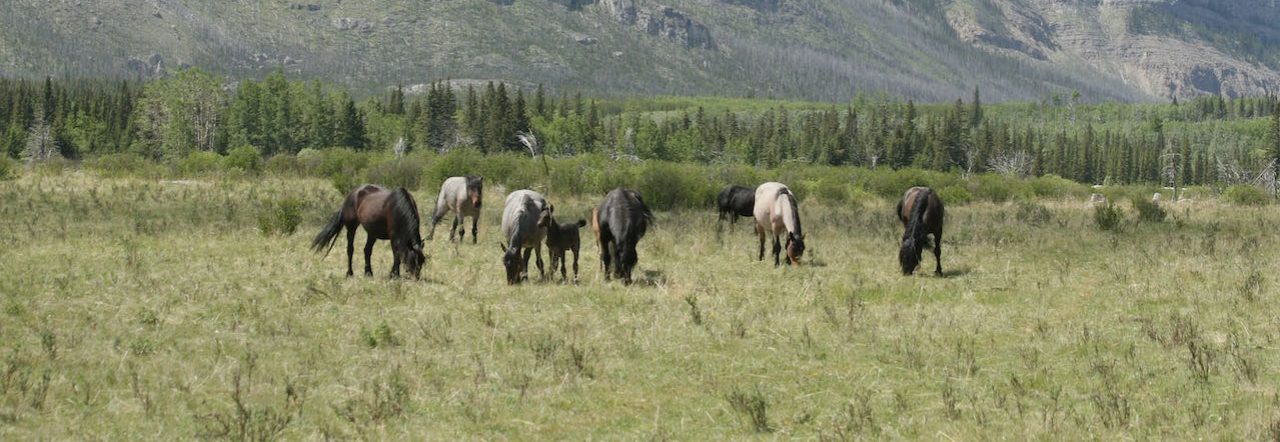
Where did the wild horses come from?
Some 10 million years ago, up to a dozen species of horses roamed the Great Plains of North America. These relatives of the modern horse came in many shapes and sizes. Some lived in the forest, while others preferred open grassland.

No matter what the breed of horse the fact of the matter is that they all originated on the North American continent. As the evolution of the horse took place, they evolved into what was the Yukon Horse (Equus lambei) which is said to have gone extinct 8 to 10 thousand years ago. This was the forerunner of the modern horse (Equus Caballus).

What I was taught and the history books state that horses were extinct in North America until reintroduced by the Spaniards in the 1500s. From their reintroduction it was believed that our First Nations people started to obtain the horse from the captured and/or escaped Spanish settlers.
Is this in fact true? Previously all this history was based solely on the white man’s accounts. Now new archeology research is showing that the horses may have been here in North America prior to the Spaniards arrival. Research from the University of Colorado and highlighted on a PBS documentary (https://www.pbs.org/video/native-horses-zwibqv/) “Colorado Experience/ Native Horses”, season 9, episode 903, is casting a new light on these beliefs. What was always missing was that the native people were never included in the archaeology history and it was solely on the rich white man’s opinion. Native verbal history is indicating that the horses were here before they saw the first conquistadors.
It is noted that in the early 1800s it was estimated that over 1,000,000 horses were running free over the North American plains.
So now “science and indigenous stories are coming together to tell the true story of the horse in First Nation’s history.” Indigenous history was always looked down upon because it was just word-of-mouth, not written down. What this new archeology research that is being done in Colorado has shown is that their oral tradition matches the archeological finds.

Visiting Head Smashed-in Buffalo Jump Interpretive Centre (www.headsmashedin.ca), tells the amazing story of how the horse transformed native culture.
The knowledge keepers of the First Nations People have tried to tell these stories for generations and only now is it being recognized. Therefore with this new knowledge it highlights the importance of our wild horses as part of not only indigenous culture, but also our history here in Alberta. Horses always played a significant role in our heritage.
When the FHAC committee was struck in 2013, what was always missing was the indigenous viewpoint. Finally when it was restarted a representative from the Stony Nation was included on the committee. The government kept insisting how important it was to have his input. I was always impressed by his knowledge and insight of the lands and the horses. One of the things he did state was that horses have been here a lot longer than was being said by the government and other stakeholders. No matter what he stated, his traditional First Nations knowledge about the wild horses and their cultural, historical and ecological role has been excluded in the government management framework.
Why? I believe it was because he was against the cattle being allowed to graze on their traditional lands. So just as the government had done to those opposing grazing leases, this input was ignored.
So the role of the Alberta Mountain Horse is important and should be preserved and shared by all for future generations. They deserve our respect. Don’t you agree?


