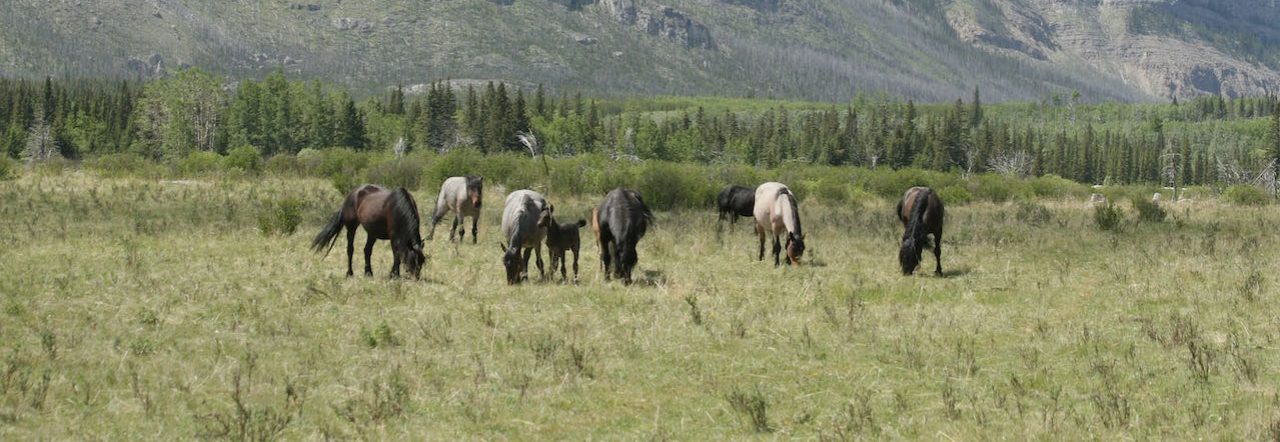
We would like to acknowledge that the Alberta Mountain Horses inhabit the traditional lands of the Stoney lyethkabi, (mountain) people.

Lately there has been a lot of discussion around the plans the government has for removing and applying a contraception vaccine to a large number of Alberta Mountain Horse mares. Despite scientific evidence disputing the need for any population control, the government is planning on going ahead with it, to hell with what a lot of Albertans and other citizens from across Canada say.
The Minister, Todd Loewen, continually misleads the public with statements about the role that the Feral Horse Advisory Committee (FHAC) played in helping make and come up with the 2023 Alberta Feral Horse Management Framework. I was one of the original members of the committee that first started in 2013 . Throughout the whole process and countless meetings, no matter what horse advocates had to say, we were ignored and the government and those on the committee pushed ahead with their agenda that completely disregarded scientific research. He often says that committee members were instrumental in coming up with population management thresholds as outlined in the Framework. This is in fact not correct as we were surprised as to how they came up with these numbers for each of the 6 Equine Zones. What was the basis for arriving at these thresholds? They could never truthfully answer and kept going back to rangeland analysis done by the lease holders and rangeland managers within the government who work with their buddies the ranchers.
The FHAC has just had another meeting of which I am not a part of since I left the other group that I started, because of their anti-wild horse philosophies. I was not invited back because they knew what I would say to about it all, (what I had stated all along since 2013), where is the science? Now another strong Alberta Mountain Horse advocacy group, HAWS, is also no longer on the committee and so it is made up totally of those opposed of to the wild horses being allowed to roam free and wild. The reason for their departure is that they refused to sign a Terms of Reference document which prohibits any member about speaking publicly about what happens in the meetings. Why do they now want this cloak of secrecy surrounding their plans against the horses? The group that I used to belong to is still part of the committee, but they are going to be receiving funding from the government to support the removal and application of the contraception vaccines to the wild horses. This is wrong in my opinion!

The government and Mr. Loewen keep saying that the Office of the Chief Scientist used countless research papers and documents in assisting with coming up with the management plan outlined in the framework. Maybe he did, but only two were based on the Alberta horses and the environment in which they live. One of these studies was done over 50 years ago and guess what, things have certainly changed!!!!
Recently some very creditable professionals have reviewed the government framework document and the information put forth by them. Also a researcher from a western university just completed and published his peer reviewed thesis on the status of the Alberta Mountain Horses and their affects on the ecosystems of the Alberta foothills. All show that this framework and the need to manage wild horses populations is not needed and is based on very misleading biased information.

In order for you to make up your own mind and allow you to more easily see and understand what information is in these independent reviews, one of our members has undertaken to analyze the information and summarize to make it easier to read.
Integrated Summary: McCrory & Boyce on Alberta’s Wild Horses
Two major recent works — Wayne McCrory’s 2024 review of Alberta’s Feral Horse Management Framework and Paul Boyce’s 2022 PhD thesis — provide the most up-to-date scientific insights on the province’s wild horses. Together, they paint a consistent picture of populations that are naturally regulated, ecologically adapted, and often overstated in policy as drivers of rangeland decline.
Shared Findings
• Population Fluctuations: Both studies document natural boom–bust cycles driven by harsh winters, predation and forage limits. Short-term counts can be misleading; multi‑year trends are essential.
• Survival & Reproduction: Mares can foal annually from ages ~3–4, but foal survival is highly variable (very low in predator‑heavy years). Adult survival is generally high, yet winters and predators periodically reduce numbers.
• Ecological Impacts: McCrory finds little evidence of broad rangeland damage attributable to horses, with larger stresses from cattle, OHVs, logging and oil/gas. Boyce’s habitat use results (e.g., reliance on clearcuts) imply a smaller footprint on native grasslands than assumed.
• Heritage & Status: McCrory highlights Spanish Iberian ancestry and Indigenous history; both works underscore the long‑standing, culturally significant presence of these horses.
Implications
Both conclude that predators, winters, and density‑dependence regulate herds without routine culls or contraception. Policy should prioritize addressing the larger human‑driven pressures on the Foothills while improving monitoring.
Population Projections (20 Years, per EMZ)
Scenario A: No Intervention

Interpretation: Natural boom–bust cycles yield periods of growth and decline across EMZs; long‑term trends remain bounded by predation, winters and forage limits.
Scenario B: SpayVac Intervention (90 Mares/Year)

Interpretation: Contraception dampens recruitment across EMZs, leading to suppressed trajectories over time, with smaller herds most vulnerable to prolonged low numbers.

We will be presenting a few more of these summaries of recent published documentations in the near future. Please help us and others that truly want to protect and save our beautiful and magnificent Alberta Mountain Horses. Let the Premier know by writing or emailing her because the Minister Todd Loewen does not care about them or to hear from you about them.
Smith, Danielle, Honourable
Premier, President of Executive Council, Minister of Intergovernmental and International Relations Relations
Office of the Premier
Executive Branch
307 Legislature Building
10800 – 97 Avenue
Edmonton, AB
T5K 2B6
Phone: 780 427-2251
E-mail: premier@gov.ab.ca
Why do you think the Indigenous groups aren’t standing loud against this twisted scheme???
Other provinces have protection for their wild horses, why can’t we obtain that? Is it just this particular group of elected officials who are do opposed?? Is it for $$$? Obviously for Todd it is. What does the UCP party gain though?
Ty
Sent from my iPhone
Elaine
There was a member of the Stoney people on the FHAC. It was all good until he voiced his opinion about the cattle should not be on the land, eating the native plants. Then he was totally ignored and they did not even inform him of the plans to go ahead with culling and contraception. They have taken a stance but are being ignored by the government’s one sided approach to all of this. Ignoring science and public opinion in favor of the money.
You do`nt have to be a scientist, You don`nt have to be an Albertan resident, You don`nt even have to be a Canadian to understand that the Albertan Mountain Horse Breed needs to be protected! Not contained, removed or reduced.
Here I sit in Sweden and understand perfectly well what is going on. TL has personal interests in wanting to do away with the wild horses. Is he being heavily paid to protect his cattle buddies? Has this been investigated?
Has anyone ever involved The World Wildlife Fund? The Albertan Mountain Horse Breed needs to be red listed!
The science is perfectly clear to all but the ones holding the power.
I don’t understand the need for zones since the wild horses continually move and cover a lot of ground. It is only natural that you may see more horses in different zones from year to year because of this. These horses need protection now as they are endangered at the numbers they are at currently. They have natural predators which are doing a good job of keeping the numbers in check. The worst threat to these beautiful and natural species of Alberta, are humans. Whether it is logging, ATVs or just driving down the back roads way too fast, humans are a huge contribution to causing unnecessary deaths of the horses.
I agree with this publication whole heartedly. Humans have to stop regulating what happens in nature, just so mankind have a their own results.