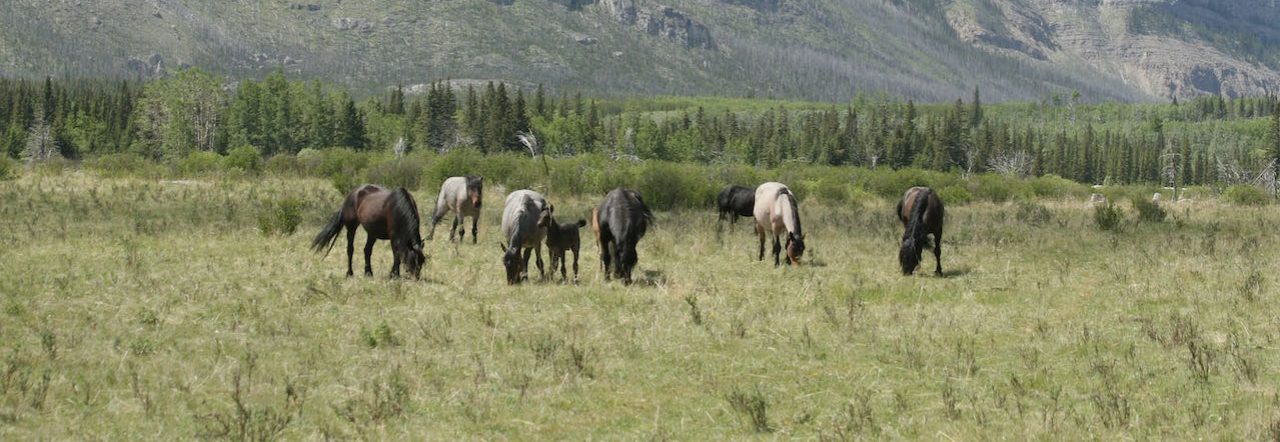
We would like to acknowledge that the Alberta Mountain Horses inhabit the traditional lands of the Stoney lyethkabi, (mountain) people.

Over the years of fighting so hard to try to have our Alberta Mountain Horses afforded better protection and to save them for all future generations, I keep having questions about why this simple thing is not being done. Continually the Alberta government has refused to take any sincere and positive steps to assure their survival. The Feral Horse Management Framework, (FHMF) that was brought forward to allegedly manage the wild horse populations in Alberta’s six equine zones is full of flaws and misinformation. It is very biased in favor of stakeholders who are opposed to sharing the land with the wild horses.

The Framework document has been reviewed by professional individuals, including Wayne McCrory, a world renowned biologist and researcher. We have talked about his review in pasts posts, but again it was not a favorable review of this management framework. It definitely appears to a me that there is an absolute refusal of those in the Alberta government who are in charge of making decisions concerning the management of the wild horses, to look beyond their preconceived prejudices against the horses. Everything they see is that the horses are having a negative affect on the ecosystem integrity of the equine zones. Even though in the framework they talk about decisions that are to be made will be based with science and data .(?)

In the FHMF it brings up the threshold numbers for each of the 6 equine zones and that this will determine the action to be taken to manage the wild horse population.
So my first question is –
How and who came up with these numbers?
The thresholds that determine action to be taken are #1 – no action needed, #2 Concern and monitoring needed and #3 population levels are unacceptable and immediate action needed. The numbers for the Equine zones are as follows.
Brazeau EMZ – Threshold 1: 18 horses and threshold 2: 30 horses – any number above that would have them culling horses.
Nordegg EMZ – Threshold 1: 64 horses and threshold 2: 80 horses
Clearwater EMZ -Threshold 1: 99 horses and threshold 2: 150 horses
Sundre EMZ – Threshold 1: 628 horses and threshold 2: 1000 horses
Ghost EMZ – Threshold 1: 226 and threshold 2: 400 horses
Elbow EMZ – Threshold 1: 84 and threshold 2: 100 horses
So where did these threshold numbers come from and who determined them? What scientific base did they use to determine them? No one in the government can tell us this. If it based on their rangeland assessments done each year then it would be very prejudicial against the horses as these are done by the cattle allotment holders using their own agrologists.

Should annual census minimal counts be the reasoning for threshold management?
Every year the government does an aerial survey of the number of horses they find in each of the equine zone. Well almost! The last couple of years the Brazeau and Nordegg areas were not counted and in 2023 the Elbow zone was not included. These numbers do vary from year to year. That is not the argument.
For several years when I was on the FHAC committee I argued that no decision to cull or such can be made on the counts for just one year. It would take 3-4 years of high stable counts to be able to make an accurate assessment on a management strategy for that particular zone. To show you the ups and downs here are the counts for the last 4 years.
2022 – Nordegg 20 / Clearwater 79 / Sundre 642 / Ghost 353 / Elbow 84
2023 – Nordegg 33 / Clearwater 97 / Sundre 969 / Ghost 311 / Elbow – not counted
2024 – Nordegg n/c / Clearwater 156 / Sundre 839 / Ghost 372 / Elbow – 111
2025 – Nordegg n/c / Clearwateer 77 / Sundre 855 / Ghost 462 / Elbow – 91
If these counts are used to determine a cull, then the system is seriously flawed. In 2024 the Clearwater and Elbow Zone showed counts over the maximum threshold that was arbitrarily chosen and the government was going to take action by a capture and contraception program in these zones. This year both are under this threshold when nothing was done, but the Ghost is way up. We are talking according to their counts, 90 horses. Are they going to call for a cull here now?
As I stated no decisions on removing horses based on just one year’s count. Also the people doing the counts are also the government people making the decisions about population control. Is there something afoot here?

Why Are the voices of the First Nations People being ignored?
When the FHAC first started there was no representative from the First Nations people and some of us questioned why they were not included. The head of the committee could not give an answer as to why they were ignored. Then when the second go round of the FHAC began, a representative of the Stoney Nation was included and he was their conservation expert and very knowledgeable as to the lands and the history of the wild horses that live on their traditional lands.
During the committee meetings his insight about the horses and the effect they may be having on the lands was extensive and thoughtful. In the FHMF that was produced as a guideline to managing the wild horses, they even state in the objectives that; “First Nations perspectives and knowledge are considered in how horses are managed” . This definitely was not done. When their representative was informed of the MOU that was signed between the government and WHOAS, he was very upset. The Stoney people were not informed about this MOU being signed or were even consulted to gain their input. Why not?
My own opinion is that the Stoney representative, remember a conservationist, had stated in the FHAC meetings that cattle should not be allowed to graze on these lands. Once he stated that he was shut out of any input into the management strategy and subsequent signing of the MOU.

Is any research being done to show what type of negative impact cattle grazing has on the rangeland of the foothills?
The whole time that I have been involved with the wild horses, I have heard over and over again that the horses are causing severe damage to the rangeland of the Equine zones and that is the reason that their numbers have to be controlled and/or reduced. When asked for scientific evidence and research to back up these claims, the government was unable to produce any to the FHAC horse advocacy groups. The office of the chief scientist for the government quotes lots of research papers on wild horses on the landscape, but all but one are from the United States. As we have stated before, these claims about damage being done by the wild horses in the Equine zones have been shown to be unsubstantiated, by professional Canadian researchers, the governments own rangeland assessment reports and even the head of ESRD at one point stated that they could not point out any specific damage.
What was pointed out from some of the stakeholders of the FHAC and other conservation groups is that it is the cattle on the range allotments in the Equine zones doing the damage and not the horses. So why is this not being heard by those in charge of Forestry and Parks, who make the decisions concerning wild horse population control?
Why is there no research being done on the negative effects of cattle grazing on our Alberta public lands? Research in other jurisdictions have shown that cattle indeed do have a negative impact. Instead of going into detailed descriptions here are some of the points that have been presented about this for you to ponder and come to your own conclusions.
1/ Cattle grazing defoliates native plants, tramples vegetation and soils.
2/ Cattle grazing accelerates the spread of exotic (invasive) species resulting in a shift in landscape function.
3/ Cattle grazing degrades riparian zones and wetlands, which are also significant carbon sinks.
4/ Cattle grazing has also been shown to remove native perennial grasses establishing the ability for exotic species to take over.
5/ Cattle grazing on public lands can have significant impacts on the environment, including soil erosion, reduced biodiversity, and increased green house gas emissions.
6/ Cattle grazing disrupts natural processes and contaminates waterways with fecal waste.
With all these factors about the negative effect of cattle grazing on public lands, why is there a refusal of our government rangeland management to look at the damage being done to the ecosystems, not by the horses, but by the cattle? Over the years I have stressed that damage in the equine zones that is blamed on the wild horses, is also being inflicted on grasslands where there are no wild horses, all along our foothills.

The future of our Alberta Mountain Horses depends on you not letting the government make unsupported decisions on the welfare of our beautiful horses. I have more questions regarding the FHMF strategies that the government outlined but are ignoring. So to be continued.
Keep supporting efforts to stop any capture or contraception by signing the petition. There is still time to get these signatures in by May 31, 2025.
Your extensive experience and knowledge about these horses is impressive and wonderful tools to combat the misinformation perpetuated by the Alberta government. Thank you for your efforts!