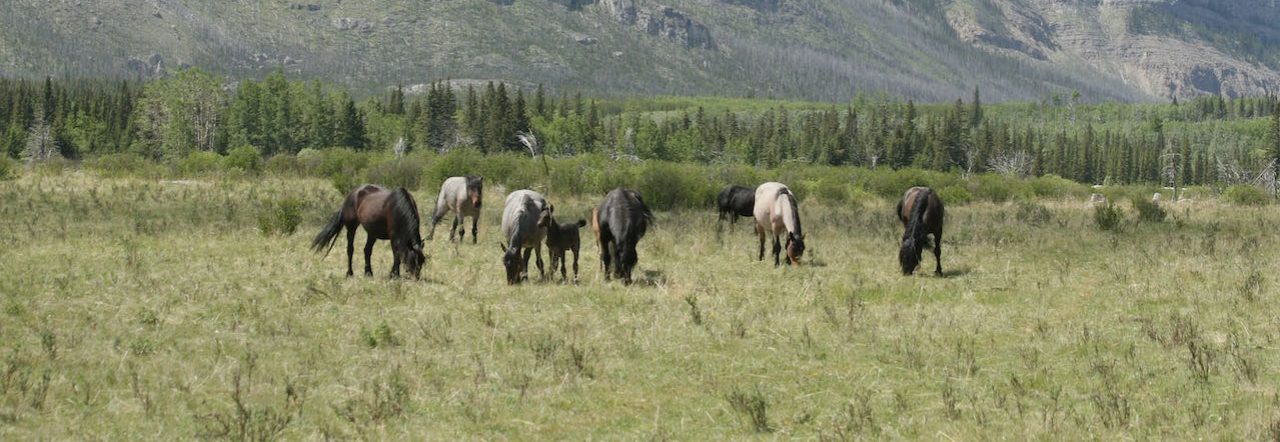
We would like to acknowledge that the Alberta Mountain Horses inhabit the traditional lands of the Stoney lyethkabi, (mountain) people.

One of the biggest arguments being used against our Alberta Mountain Horses is that they are consuming the available forage in the Alberta equine zones and thus taking it away from the cattle and the other wildlife. The government is continually feeding us misinformation to justify their attack on the horses. Now I will be the first one to admit that I do not have a degree in agronomy but these observations are based on over 60 years of experience in the Alberta foothills and mountains.
Grass is one of the most hardy and diverse plants and despite overuse will always come back the next year. However over a period of time it can be degraded and its biomass reduced through chronic overgrazing. In my observation over the years this is what is now happening. It is definitely not the horses that are doing this, but it is the cattle that are responsible. Several well known scientists and agronomists have documented and researched this which shows that only over grazing decreased grassland biodiversity. Also, it was determined that above ground biomass is more sensitive to grazing than below ground biomass. Then when you include drought conditions by the end of summer in areas where cattle grazing has taken place, there is absolutely nothing left.
Another factor to consider is that other plants including noxious weeds take over in areas that have been overgrazed. Weeds are seldom a problem in vigorous, well managed rangelands. These weeds diminish the productivity of an area, threaten biological diversity, but reduce structure and function and sustainability of the ecosystems. Another reason that overgrazing negatively affects the range. Over grazing not only affects rangeland health, but also has a very large negative impact on all our wildlife that calls these lands home.
One has to consider the difference between cattle grazing and horse grazing. Cattle graze by using their tongues to wrap around the plant and pulling it up. At times that can be the whole plant including the roots. Horses in the meantime are constantly on the move and use their front incisors to nip off just portions of the grass as they move about. One of the arguments used to allow the cattle onto the public lands is that they mimic the buffalo in grazing patterns, and thus allegedly reducing the fuel for fires. However, again this is not true fact. Cattle move into a particular part of the lease and will camp there until the food source is gone then only then will they move on. Horses on the other hand are constantly on the move never staying in one place too long and this is how the vast herds of buffalo used to keep the prairie grasslands healthy. Just ask our Indigenous peoples about this. In our opinion the horses should be used instead of cattle to maintain good rangeland health. Horses are here all year round and now some research has shown that grazing in the nongrowing season, i.e., winter, is a benefit to grassland management. So leave the horses alone…they are helping, not hurting!
To hear the government officials talk about the reasons for having to reduce wild horse numbers, it is because they are blaming the horses for the damage being done by the cattle. This is not true. One only has to go outside the equine zones and into the grazing leases where there are no wild horses, to witness that the damage done in the equine zones is just as bad or worse. In these areas where overgrazing has happened we know that in the spring the grass will hopefully return, but it is these areas that the wildlife (elk and deer), rely on for winter survival. What I have seen repeatedly is that there is very little left for them. Look at the Sheep River valley where there is a bighorn sheep sanctuary and the cattle by the end of summer have eaten all the grass in the valleys and have migrated up onto the high ridges before they are removed by October 15th each year. Again no wild horses here. And nothing left for the sheep.
There is so much more that can be said about rangeland health and lots of research is occurring which much of it conflicts with the government’s basis for the Feral Horse Management Report and the removal of horses. (I hate the word “feral” as it so demeaning to such wonderful creatures!)
Let’s Look at the Numbers
Here are some numbers to help you make up your mind about this situation.
The province of Alberta has six equine zones where all this controversy surrounding the horses is focused. In total these equine zones encompass 5,603,710 acres. In 2024 the total number of horses counted was 1,478. There are a total of 33 cattle grazing allotments in these zones and in these allotments during the summer there are approximately 34,200 cow/calf pairs that are allowed to graze. To be fair though, the Nordegg and the Brazeau zones each have over 1 million acres which are unsuitable for cattle grazing and wild horse habitation. In fact, the Brazeau has no cattle allotments and the Nordegg has two. The last count done for horses in these areas in 2023 showed the Brazeau had 18 horses and the Nordegg only 33 horses. There was no count done in 2024. Also in the Elbow zone, which incorporates 444,565 acres, horses are only found in the northern part where the count was 111 in 2024. It is this zone though that the government has plans to remove some horses. Why is this? Is this because the government is getting pressure from lease holders who want this land for their cattle?
How does the government arrive at these reasons for allowing the number of cattle (AUMs)? Each year rangeland assessments are supposed to be done by the allotment holders. These assessments are done through guidelines laid out in the “Rangeland Health Assessment for Grassland, Forest & Tame Pasture” on public lands established by the government of Alberta. Even these assessments are biased but in an analysis from 2015 done by an agronomist for Zoocheck shows it is indeed not the horses that are negatively affecting the rangeland health. Another point is that the government will not willingly allow access to assessments done since 2015. Why is this…what are they afraid of?
So in fact it would appear to many of us that 33 individuals or grazing associations are dictating to the government that there are too many horses and they should be removed. What do you think?


We will be continuing with more information coming soon. Keep up your good work writing to the government about your concerns. The Alberta Mountain Horse Society and the horses thank you!
Great update of information. Thank you.
I hope that this gets into the hands of the government who will logically see the merits in the wild horses grazing on crown land as opposed to the cattle. Anyone who has cattle can attest to what they even damage in the forest let alone the grasslands.
this is an eye opener for sure and a very informative article. The government definitely is hiding the truth about our public lands and bowing to the pressure of the cattle industry!
How do ranchers get permission to graze their herds on government property? Who is in charge of issuing permits for this to happen?