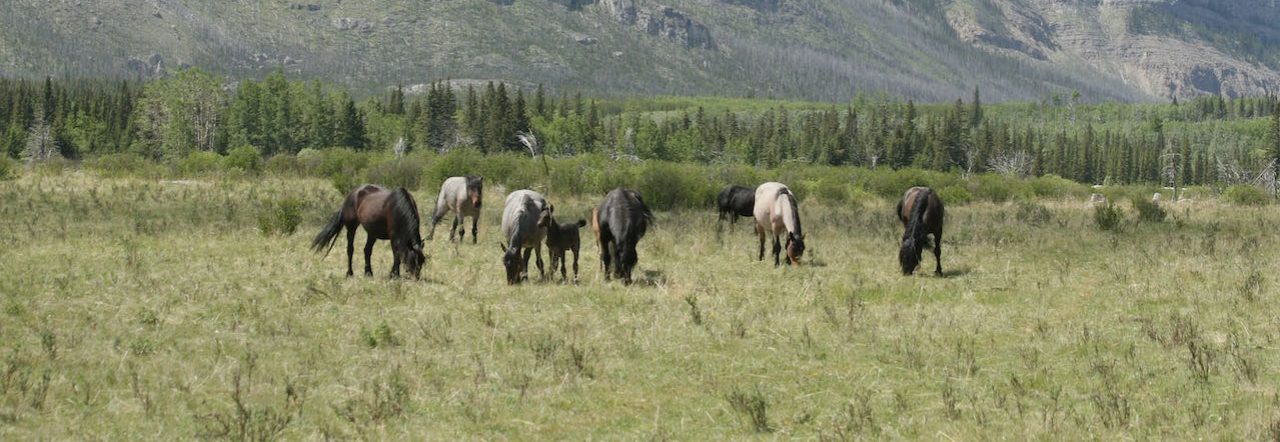
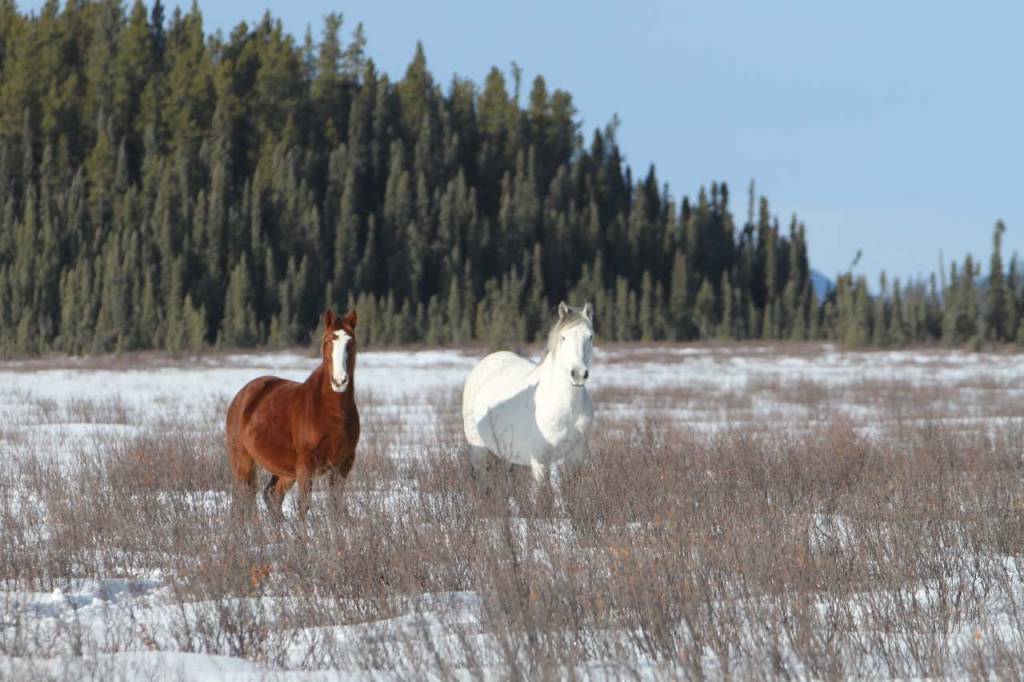
We would like to introduce Claudia Notzke, PhD, who is a life-long advocate for our Alberta wild horses. She has travelled the world studying and supporting wild horses in different countries, especially here in Canada and Alberta. Her knowledge of wild horses we believe is comprehensive and inclusive. With her permission we would like to share her analysis of the Alberta government’s latest plans on the wild horse management file. We hope when you read her article you’ll be inspired again. The Alberta Mountain Horse Society is in agreement with all her points.
She has several important points you can include if you are writing or emailing government officials. We know it is frustrating to keep getting back their response in a form letter. However, your efforts are important and we appreciate all of you who are working with us to stop any culls or contraception of our beautiful Alberta Mountain Horses.

The Fight to save Alberta’s Wild Horses
Claudia Notzke © 2024
Many Albertans (and Canadians) are unaware that wild horses exist in the Rocky Mountain Foothills. And yet they have been an indelible part of this landscape for more than three centuries, sharing this ancient landscape with the mighty bison prior to their near extinction. The fate of near extinction is being shared by the wild horse. Throughout the 20th century their numbers were reduced to a small fraction of what they once were due to bounty systems, unregulated capture, and indiscriminate killing. Over the past 50 years, under public pressure, attempts were made by the provincial government to remove the most blatantly inhumane elements from wild horse capture, but this has not prevented the
majority of caught animals from being slaughtered, and illegal poaching of horses continues unabated.
After a decade long reprieve (in response to public opposition to unsustainable captures) the Alberta government is planning another cull for this coming winter. This time the cull is being rationalized to the public under the guise of “science-based management”. This approach is being outlined in a 2023 government document entitled “Feral Horse
Management Framework”. This document was subjected to a detailed (peer-reviewed) analysis by Wayne McCrory, an objective, highly reputable and experienced wildlife biologist. His report constitutes a devastating indictment of a government’s failure to adopt a science-based and evidence-based approach to managing the wild horses of Alberta’s
Foothills and extensively documents the government’s lack of transparency and public accountability while being strongly suggestive of institutional bias and lack of objectivity.
After a thorough study of both documents and based on my own almost two decades of researching wild horses in my home province of Alberta as well as throughout Canada and worldwide, I whole-heartedly endorse this eminent biologist’s conclusions. One of his important observations is the fact that the entire government document is long on
assumptions and short on scientific data and proof. The Foothills free-roaming horse population is being isolated and targeted for controversial and questionable control measures with minimal evidence supporting that they are a serious threat to rangeland health. No data or information whatsoever are provided on other contributory factors of
cumulative effects, such as cattle outnumbering the horses 7 to 1, clearcut logging or heavy OHV traffic. No scientific accounting and quantitative information on the level of grazing pressure by 8,544 head of cattle is being provided in the Framework. One of the most disturbing observations is the government’s apparent suppression of its own data
documenting that the majority of range damage is caused by industry and recreational activities. Over the years, McCrory as well as myself have been frustrated by the government’s (and industry’s – in my case forestry’s) inability to document wild horse caused damage to the ecosystem.
Another point that is extremely troublesome is that the entire governmental management approach is based on a faulty premise. The very fact that the Framework remains positioned within the management confines of Alberta’s Stray Animals Act runs counter to the true identity of the free-roaming horses. Neither are they strays, i.e. recent barnyard
escapees, nor are they non-native (like cattle). There is abundant peer-reviewed scientific evidence that would justify a reclassification of these wild horses as a returned native species to an ecosystem that has been home to them for millennia. It is a well-known fact that North America gave rise to the family Equidae (horse!) almost 60 million years ago.
Over a period of hundreds of thousands of years various subspecies and/or ecotypes of Equus Caballus coevolved with their habitat in North America while undergoing extinctions, migrations to Asia and return migrations. North America’s last extinction only occurred about 5,000 years ago, much later than assumed until recently, a mere blink of an eye in
terms of ecological time. Not only is this “big picture” conveniently overlooked by government managers, but Alberta’s Foothills horses themselves are being misrepresented.
They are not strays but animals filling a vacant niche in our Foothills ecosystem. They BELONG- naturally, having returned to their ecological home as well as representing a unique cultural history. A recent genetic analysis of Alberta’s wild horses by reputable equine geneticist E. Gus Cothran of Texas A&M University revealed a strong preponderance
of Spanish breeds ancestry in Alberta’s wild horses in addition to a connection with the Canadian Horse, Canada’s National Horse. Due to indigenous people’s trade (and natural expansion?) these horses entered today’s Alberta long before the first Europeans did, and have mirrored our own history in this province ever since.
They are not ecological misfits but fully integrated in their ecosystem with positive rather than negative impacts on their habitat and other species. They are unique amongst the world’s free-roaming horses in having to contend with a full suite of large predators resulting in an extremely low rate of foal survival. This reality flies in the face of current
governmental management goals. According to the IUCN (The World Conservation Union) Equid Specialist Group a minimum population of 2,500 mature individuals constitutes an important threshold for a species to be considered Endangered. The current count of wild horses in Alberta’s foothills of <1500 individuals is not even close to that. This population is comprised of sub-populations which are not in contact with each other. The past decade without a cull has not resulted in a population explosion but rather shows a dynamic equilibrium typical of many wildlife populations, with some variability. Alberta’s wild horses are very effectively (not to say brutally) managed by natural selection. There is no
need for human intervention, neither by birth control nor removal.
The government’s action plan shows no consideration for the genetic viability of these populations which speaks to the fact that the animals are being managed as a nuisance species rather than a valued ecological and genetic resource. The proposed population thresholds for individual Equine Management Zones in the double digits are a mockery of
sustainable populations for any species, and are not rationalized by any evidence, scientific or otherwise.
In summary, there is strong indication that Alberta’s wild horses are being managed out of existence. The provincial government’s “science-based approach” makes a mockery of science and constitutes a travesty of resource stewardship. It appears to be a purely political move in response to a small but vocal lobby of ranchers, outfitters and forestry
interests while running roughshod over a large number of other stakeholders: a rapidly increasing number of photographers and artists whose vocation is inspired and nurtured by wild horses; the many recreationists whose overall experience is enriched by an encounter with wild horses; the large number of tourists -domestic and international- who
come to pay homage to this widely acknowledged symbol of freedom and western heritage; and the countless Albertans and Canadians who may never see a wild horse and yet are inspired by the very existence of wild horses leading self-determined lives.
Claudia Notzke Ph.D.
The author is a geographer, Professor Emerita at the University of Lethbridge AB, wild
horse researcher and lifelong equestrienne.
 Alberta Mountain Horse
Alberta Wild Horses are VERY Important to the Horse Industry of the World
LikeLike
Thank you so much for sharing this excellent report from Claudia Notzke. I agree wholeheartedly!
LikeLike
Thank you! Wonderful additional information to include in emails to those supporting a cull and sterilization of our irreplaceable wild horses!!
LikeLike
I’d like to add this observation. Over the past few years, ethnographic studies of wild horse populations has led to a greater understanding of horse behaviour. These understandings (such as a new understanding of “dominance behaviour”, the fluidity of leadership and the importance of family groupings) has and will continue to impact our husbandry of domestic horses in a positive manner. These horses have much to teach us.
LikeLike
Excellent article with grave warnings to the Alberta officials who seek to destroy wild horses. The genetic equilibrium is vital to these beautiful wildies. To destroy this is ludicrous. I hope the upper officials of Canada will intervene to this insane plan. The world is watching.
Patricia Timlick
Columbia Falls, Montana
LikeLike
I can only hope this information halts the egregious action being suggested by the boys with toys. The horses tread so lightly on the land and contribute so much, I cannot fathom the inability of these people to THINK, to understand the cooperation of ecosystems, and the connectivity of all things in balance. Fools with their hands in someone else’s pockets.
LikeLike