Cause for Concern

Zoocheck has done a press release in regards to an upcoming Alberta government cull of our Alberta Mountain Horses. We have attached the information.

This release was formulated from the research and analysis undertaken by Wayne McCory, a world renowned biologist and author. Mr. McCrory has published several research papers on BCs wild horses and in 2015 had also done one for Zoocheck on Alberta’s horses. His book, “Wild horses of the Chilcotin” outlines their history and future on the landscape.

His report on Alberta’s horses in 2015 was very thorough and was presented to the Feral Horses Advisory Committee (FHAC) of the Alberta government. It was quickly dismissed by several stakeholders and the government as not being relevant because it had not been “peer” reviewed. In other words, they did not want to hear it. His current report reviews the FHAC management plan that was finalized and approved by the government, but not by all committee members.

At stake now is the upcoming plans for a completely unnecessary cull of horses in two of the equine zones.

Through our experience and travels throughout wild horse country our observations back up what Mr. McCrory states in his report. That is, it is not the horses that are doing the damage to the environment, but is the severe overgrazing of the range by cattle put out on Crown land. As well other pressures from logging, oil and gas, and recreational use all contribute. This narrow-minded attitude on behalf of the government that it is the horses that are to blame for the degradation of the landscape and the negative effects on other wildlife.

I have brought up several times in the FHAC meetings that the damage they say is caused by the horses is limited to the equine zones, but this is not true. Several times I have mentioned that in areas where there are no wild horses and there are cattle during the summer, the degradation to the range and the riparian areas is just as severe if not worse. My own experience is through spending over 60 years in travelling, hunting, hiking and camping and in that time the changes that I’ve observed is phenomenal.

To make my point one can visit the Sheep River bighorn sheep sanctuary west of Diamond Valley. In the springtime when we first start riding, there are no cattle and the grass is very lush. It is here that the grazing association has put out a sign that states that cattle are benefiting the landscape by eating the biomass. However on a viewpoint overlooking this sanctuary is a sign stating how the sheep are staying within the safety of the sanctuary all year and because of that the range is suffering. How ludicrous!
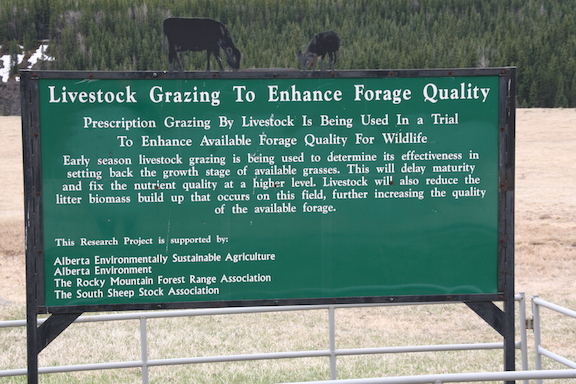
Sheep sign

Because of the cattle by the end of summer the grass has been eaten down almost to bare ground in the valleys and on the lower hillsides. It was so bad last year that the cattle had ranged high up on the hillsides to find enough feed but this was the winter feeding ground of the sheep and elk. What were they to eat come the hardships of winter? We know the grass comes back every year, but like we have said, the wintering areas for the wildlife has been destroyed and there are no wild horses here. To us this is absolutely total mismanagement and poor stewardship of our Crown land by the grazers and government land managers. So when it comes to the Equine Zones it is the cattle not the horses destroying the landscape.

We hope you will consider following Zoocheck’s request and contact the government to express your opinions. If you click on the link at the top of the page you can find Zoocheck and Wayne McCrory’s report.

Alberta Mountain Horse Preservation Society 2025 Calendar

Who are the Alberta Mountain Horses?

They are Alberta’s free-roaming wild horses living on our Eastern Slopes in the meadows and mountain valleys of the Alberta Rocky Mountains.

Our society has been established to educate Albertans and the general public about these horses and the historic importance they have had in the development of our province.

We strongly feel they should have a specific designation (Alberta Mountain Horse) and have specific protection for them so that they can remain free and unharassed on the landscape for all future generations.

We hope you enjoy our first calendar with photos and stories about the wild horses we have seen this past year. Funds will go towards registering our non-profit society.

Calendars can be ordered by sending cheque or money order. The cost which includes mailing is $25 each.

Alberta Mountain Horse Preservation Society,
4405 Shannon Dr, Olds, AB T4H 1C1

The Life Of A Wild Horse

2010 Foal
2010 Foal

Sunday night, October 3, I was sitting at home when late in the evening the phone rang.  On the line was a friend of mine Bunny, who with her husand Al, hail from Grand Prairie.  They had been down, riding the west country looking for wild horses and they had come across a 2-3 month old foal who appeared to be in distress.  It had company but, the company was two young studs, there was no mom around.  They attempted to see what they could do, but were unable to catch the young thing and they did have to head all the way back home.  Hence the phone call.

I had to work Monday but promised Bunny that as soon as I could get off work, I would head out to the location where they had spotted the foal and see what I could find or do.  Monday afternoon I slipped out of work a little early, grabbed a lariat, blankets and some soft rope and off I went. Travelling in my vehicle I toured up and down the trail where they had last seen the foal.  I did see wild horses and will expand on that later.   However, I had no luck finding the two young studs or foal.

I then decide to go out on foot and explore further back into the clearcuts.   I travelled into several of the clearings looking for some sort of sign.   The sun got lower and the light began to fade as I continued to look.  Just as I was way in the back of one cut block, in a muddy patch, there was some fresh huge grizzly tracks.  The hair on my neck went up as I tried to hurriedly picked my way through the stumps and ground clutter, back to the vehicle. In the dark I stumbled through it, unable to see very much, but on high alert for bear.

When I got back to the vehicle I sat there quietly thinking about the foal and hoping for the best for it.  One thing does keep my hopes up that I still may find it alive is that there were no flocks of ravens around.  They tell all when you are in the forest and that meant that there was nothing fresh dead in the area.  I prayed for the foal and started back home.

The reason I titled this The Life Of A Wild Horse is how I was thinking at the time.  This year has been a good year for the wild horse foals. We have rescued some and a good percentage of the 2010 crop are doing fine.  However foal mortality this year is still around 20%.   The life of a mare can be a hard one also, as the stallion’s herd grows, the dynamics of the herd mares changes also.  When foaling there are no vets to come to their aid if something is wrong.  They, with the help of the stallion, will try to protect their foal from anything, even if it may cause them harm.  Occasionally also they or a foal will be injured when another stallion challenges the herd boss.  Life is not easy and nature at times can be harsh, especially in winter.

Then while looking for the foal, I came across one of the stallions that if knew so well, I fully realized the hardships these magnificent creatures face.  For what I came across was a stud we called Socks.

My ex-wife and I had come across him in the middle of a snowstorm several years back.  He made an immediate impression on us both at the time with, his high white markings on his left rear leg.  He was just starting his herd and had two mares and yearling with him. Over the next few years, everytime we came across him he would always put a show on for us.  He was so photogenic and has appeared in our WHOAS calendar two or three times.  I also have photos of him on the walls of my home.

This time things were tragically different and my heart broke.  He was with another lone stud.  Socks was beaten up pretty bad with gouges and bite marks covering his body.  He had gone past his prime and had just lost his herd to an up coming dominant stallion.  He was looking so forlorn and I cried for him.  I could not even take any pictures of Socks as I care to remember him in all his glory.

Socks

The fight of the stallions can be ferocious at times and sometimes even fatal.  Most of the time though, the victor chases off the vanquished with no real harm done.  Though, sometimes there are broken bones and or open wounds from the biting and kicking that takes place when they fight.  When fighting the squealing can be heard echoing through the hills.

Socks will wander off on his own and his life will end quietly.  It has been such a pleasure of mine to have known this stallion.  He has filled my heart with joy several times.  One time I came across him as he pranced out in front of his herd toward me, trying to protect them.  One of that years colts came running after his dad and put on a bluff just like he did to warn me off.  What a thrill.

It is not only him, it is all the wild horses I have come across over the years that bring  such joy to my soul.  The pleasure I take in photographing them so that others can enjoy and see their beauty, is immense.

Wednesday is my day off and I bet you can guess where I am going and what I will be trying to do.  Maybe I can find someone to help me.  Thanks to you all for your support of your wild horses.

Bob.

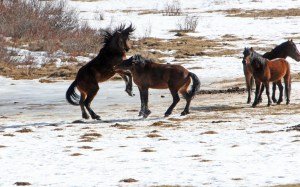
Getting Ready.  The Practise Fight.
Getting Ready. The Practise Fight.

Nature Alberta Magazine

In the 2010 summer issue of Nature Alberta, which is a magazine for the Federation of Alberta Naturalists, there is an article on the Wild Horses of Alberta. The article is called, Western Canada’s Wild Horses – The Struggle for Legitimacy. It was authored by one of the wild horses staunchest allies, Dr. Claudia Notzke.  Dr Notzke has an amazing list of credentials behind her name when it comes to dealing with wild horses throughout the world. Extremely well written, it gives a very sound scientific argument for the protection of the wild horses as a native species, here in Alberta and North America.  In her article Dr. Notzke also visits the ecological opportunities in preserving the wild horses in their natural environment, the need to revisit the current management practices, the need to have an open mind in order to change attitudes toward the wild horses and what they should mean to all of us. Thank you Claudia.
Bob.

A Mustang’s Tale, by Dorothy Larkin

I run through the fields wind at my feet

My band behind me not missing a beat,

Something is wrong that I can not see,

I feel in my heart the tremble in me,

We run from a stranger with malice intent,

But they keep getting closer our energy spent,

Then a loud noise and a hot searing pain,

A warm bloody substance from out of my mane,

I fall to the ground no longer can run,

My foal by my side I tell her to run!! Run!!

But she stays by my side as the enemy comes,

 Laughing and yelling, Oh what have you done?


As they approach I wonder they hunted me why?

Was it for food or just to watch me die?

I looked into their eyes and pleaded take me,

But let my foal run, run and be free,

I looked at my young and said my goodbye

A tear was falling out of her eye,

My band of horses stood helpless away

neighing and snorting, they called for my bay,

 They trusted this enemy the one they call man

They turned and start running as fast they can

Another shot rang out, then she dropped my side,

I nuzzled her gently while she quietly died,

Another two Mustangs were murdered today

By the ones that they trusted so senseless to say,

I hope that our future will let us be free

We are all of God’s creatures why can’t you see.

Alberta Mustang, the true Canadian NWMP Mount. By Gail Praharenka

      In light of the recent shooting of an Alberta wild horse north west of Calgary it is fitting that one comes to understand that this death is not just about a horse but a legacy that western Canadians own and created; a past so rich, sadly so forgotten that if one understood the significance I wonder that maybe finally the law would protect not just an animal but a tradition that epitomizes the heritage of the western  provinces, cowboys and a police force in mounted form that staked out the claim of freedom for all and made the west a peaceful and free place to settle. It may be said that Canada lacks a common heritage, however heritage has to be appreciated to be valued.  One thing is for sure the west holds claim to cowboys and a way of life that was both rugged and romantic; the rider facing long rides across vast prairie and foothills of these great provinces. And as Westerners we should honor the mustang or wild horse as a symbol of a conveyor of the law, the principle strength of the Royal Mounted Police force in its infancy in 1873; without which you can’t have the mounted part, as then a man without a horse had a long walk across the prairies. The wild horse of the west is the true mount of the RCMP.

     If you look past to 1873 and understand that the 278 eastern breed horses were given to the first RCMP stationed in what was the Stone Fort north of Winnipeg and  Fort Garry were brought out by train to the 350  troops, 16 officers before their long march west into the new province of Manitoba, and the newly acquired lands of the Hudson Bay Company: the North-West Territories which consisted of B.C, Alberta, Saskatchewan and Nunavat. Those horses march the newly formed Police Force that Prime Minister John A. Macdonald wanted as a force of mounted rifles to establish peaceful law and order among warring native American tribes, to protect them and settlers from American whiskey traders, mandated to clean up Fort Whoop up and other whiskey trading forts and to stop illegal liquor trade.  The Prime Minister’s plan was not a military force blood covered as was the notorious US Cavalry but a well respect peace officers fashioned in principle along the Royal Irish Constabulary; an efficient run civil body under military discipline well trained with a single purpose to keep peace as was their motto “uphold the right”. The principle worked as our history shows that early RCMP were stoic men with grit and dedication to the policing of a vast early wilderness with respect held for all peoples and that all respected the fair laws meant to govern brought by them. Major James Morrow Walsh-(a true Canadian hero) was one of the leaders to make the early trek west in 1874 leaving Dufferin on the banks of the red river just north of the Dakota border. The RCMP had bodily strength to ride into the prairies but their naivety of the west was obvious and within a week of the trek  those eastern breed horses did not have the stamina to withstand the long vast prairies distances, the hot arid landscape with little food and water. In Ian Anderson book “Sitting Bull’s Boss” he writes that “two months and 700 miles out from Dufferin” and into the “Great Lone Land”… “34 eastern horses selected had fared poorly compared to the mongrel mustangs most of his officers favored” by the time they had reached Fort Benton many more horses had died. Obviously  those officers begun to understand the rigors of our western landscape demanded a horse bred and naturally made to survive here. Henri Julien was an artist with the Canadian Illustrated News sketched the trek of the RCMP and the picture of the hand picked mounts were of dying horses on the unforgiving trail. Those early days saw the RCMP make better decisions in tuned to the west, early guides such as Jerry Potts were employed as astute Native Americans knowing the land and where to find the trading forts and they acquired horses which were native American prairie ponies traded and bought from natives and ranchers living in the west.

     The early clean up of Fort Whoop up and the ambassadorial meetings the RCMP did with many tribes such the Blood, Assiniboine, Cree and Blackfoot was an immense undertaking, the distances covered were daunting; from Fort Macleod  in the fall of 1874 Inspector Walsh with a small party went south towards Fort Benton again to winter their horses and get supplies; they covered 400 miles on horseback and returned to Fort Macleod Christmas Eve! The spring of 1875 again saw a trip to Fort Benton country to claim the herd and purchase more suitable mounts; more hardy mustangs-the “Indian pony”. It is a presumption to think that the Native Americans did not have a high standard of breeding, the Sioux and Sou shone as well as the Nez Perce traded off poorer quality animals and practiced gelding of stallions to produce their prize ponies. Their horses obtained from the wild and traded from other tribes were rigorously tested on decades of hunting trails chasing deer and buffalo.

      For the RCMP the late 1800’s were tenuous times. 1873 saw the massacre at Cypress Hills from a group of American wolfer’s against the Assiniboines; this act moved Macdonald to form the NWMP. In 1876 news reached Ottawa of Custer’s last stand and that the resulting hostility of the US military drove the Sioux north into Canadian soil to use Canada as a base to continue their warfare. Sitting Bull’s camp was at Wood Mountain. A few days ride away from Wood Mountain B Troop stationed at Fort Walsh under the command of Major Walsh had been sent reinforcements from the north-100 RCMP were transferred  to the Fort Walsh post and to Fort Macleod. And fears for the RCMP were well placed  as the Sioux had spoken with the Blackfoot Chief Crowfoot to join with them to fight their common enemy the blue coats of the south; with this unity the Native American alliance would have been invincible. Major Walsh and his men patrolled the border and country between Fort Walsh and Wood Mountain November and December of 1876 meeting with the Sioux; it took several days to ride on horse back (not in a warm patrol car) to reach the camp and there would be many rides back and forth for the years to come.

       Those early years prior to 1900 saw the RCMP patrol this vast country on horses as strong and determined as they were, and if you study those old photos you can see the dust from the countless trails, the officers did not wear their redcoats all the time, to do so meant dirtying your uniform; they wore buckskins leather jackets, leather hats to shade their faces from the hot sun, and chaps and boots to protect from brush and sticks on the trail. The pictures tell a brave story and the horses are often the star of the photos for those men hold these horses in high regard; they were the backbone of their accomplishments and meant living or dying in a wild frontier, our western prairie. All the horses are stout native ponies, mirror images of mustangs; they are not the black long legged warm bloods seen in todays RCMP musical ride; their elegant dressage stature does not reckon with the useful form and toughness that is seen of the first police horses, yet they also preform the calvary drills. I wonder where we would be had it not been for those gritty RCMP preparing peace in the land for our ancestors’ arrival. And of  their horses which carried them over miles of wilderness; a testament of stamina. Of course we value our police and the traditions of the RCMounted P are evident; everyday you see a patrol car there’s a picture of a long legged dark horse and rider with the redcoat. A wonderful tradition we should be proud of; but a bittersweet tradition as the politics outranks reality and the dark long legged picturesque creature Ottawa wanted is the chosen photo mount of our soldiers. Yet that horse failed the western test and the true spirit of the Canadian west is shot down.  Our traditions need to be saved and upheld; the NWMP-now a national icon was given to west as police officers, then the west shaped them as heroes on horseback. Now our wild horses of Alberta need saving and given its rightful place of honor and remembered as the first true Canadian mount of the NWMP.

 Gail Praharenka